6 Best Humidity Monitors for Indoor Plant Rooms
Indoor plant rooms fail when moisture levels drift outside the narrow band tropical foliage demands. Calatheas crisp at 40% relative humidity. Ferns abort new fronds below 50%. The best humidity monitors for indoor plant rooms eliminate guesswork by providing continuous, calibrated feedback that allows you to maintain the 55-70% range most aroids, ferns, and rainforest species require. A $15 sensor prevents hundreds in plant loss.
Materials
You need three categories of equipment to monitor and respond to humidity data effectively.
Digital Hygrometers (Calibrated Sensors)
Select devices using capacitive polymer sensors rather than resistive chips. Capacitive models drift less than 2% annually. The Govee H5075 offers +/- 3% accuracy with Bluetooth data logging. The ThermoPro TP50 provides standalone readout at +/- 2% accuracy for $12. Mount sensors at canopy height, not floor level, where microclimates differ by 15-20%. Avoid direct misting zones, which skew readings.
Hygrostats and Controllers
Inkbird IHC-200 combines sensor input with relay switching to automate humidifiers when levels drop below your setpoint. Wire it to a cool-mist ultrasonic humidifier rated for your room volume. A 200-square-foot grow room needs 3-4 liters per day output to sustain 65% humidity in winter when forced-air heating operates.
Calibration Standards
Purchase 75.3% and 33% salt-based calibration kits (magnesium chloride and potassium chloride solutions). Seal your sensor in a jar with the standard for 24 hours annually. Adjust offset settings if readings drift beyond manufacturer spec.
Timing
Install humidity monitoring before acquiring sensitive specimens. Hardiness zone matters less indoors, but seasonal vapor pressure deficit (VPD) swings dictate intervention intensity.
Winter (December-February)
Heated indoor air in USDA Zones 3-7 regularly drops to 20-30% relative humidity. Install monitors in October. Run baseline measurements for two weeks before introducing plants sensitive to low humidity. Supplement with humidifiers producing 0.15-0.25 gallons per hour for every 100 square feet.
Summer (June-August)
Zones 8-10 face inverse problems. Air conditioning strips moisture. Coastal growers in Zone 9B may sustain 60% ambient humidity, but AC units dehumidify aggressively. Monitor dewpoint, not just RH. A 72°F room at 65% RH has a dewpoint of 58°F. If AC coils run colder, condensation pulls moisture below plant-safe thresholds.
Shoulder Seasons
Spring and fall offer natural humidity in the 45-55% range across most zones. Use this period to acclimate new arrivals and test sensor placement.
Phases
Phase 1: Baseline Assessment (Week 1-2)
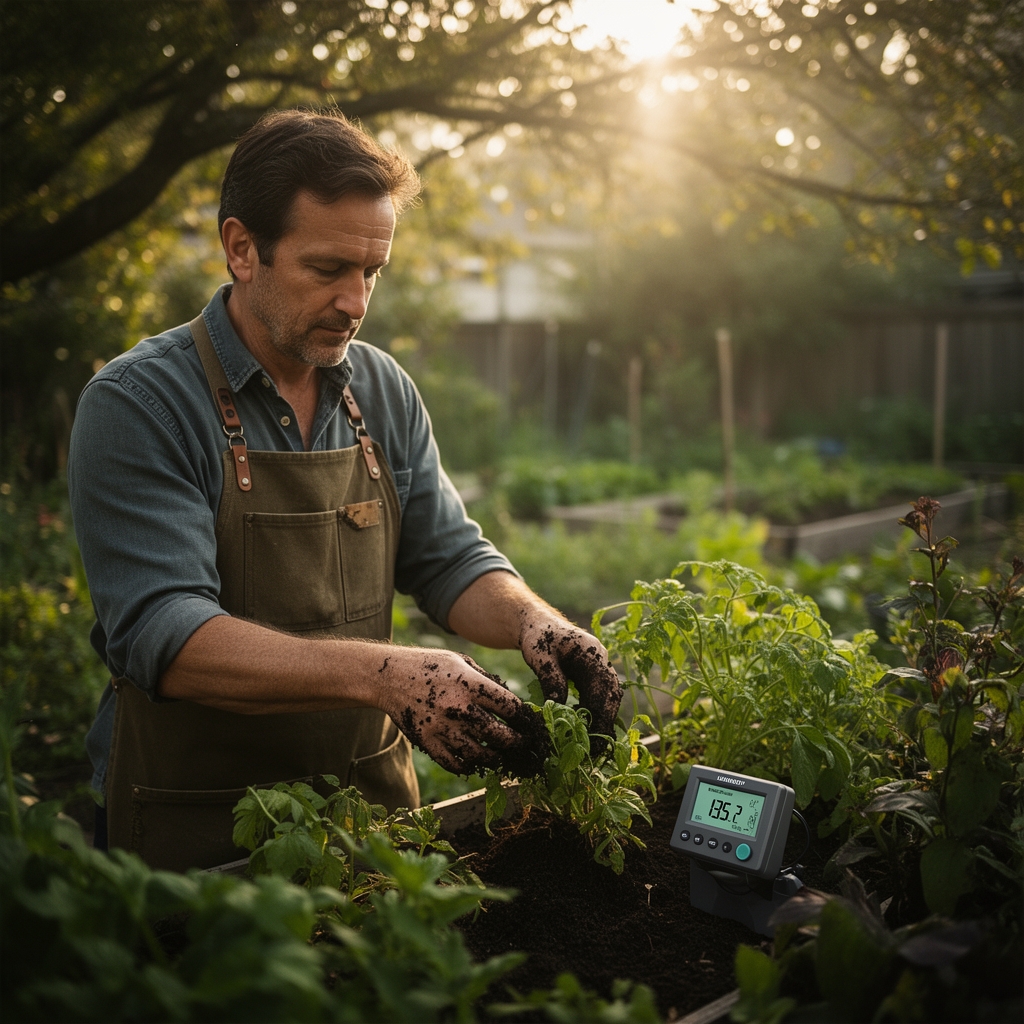
Place three sensors at lower, middle, and upper canopy levels. Log data every 15 minutes using Bluetooth-enabled models. Map humidity gradients. Rooms with passive air exchange show 10-15% RH variance from floor to ceiling. Identify microclimates near windows (drier) and interior corners (moister).
Pro-Tip: Run sensors for 48 hours before adjusting. HVAC cycling creates false lows. Daily averages matter more than instantaneous spikes.
Phase 2: Intervention and Stabilization (Week 3-6)
Deploy humidifiers when average RH falls below 50%. Position units to avoid direct mist contact with foliage, which promotes bacterial leaf spot. Use distilled water to prevent white dust from mineral aerosolization. Integrate oscillating fans at low speed to distribute moisture evenly and prevent stratification. Fans also enhance transpiration efficiency by replacing boundary layer air.
Pro-Tip: Add a shallow gravel tray filled with water beneath benches. Evaporation contributes 5-8% localized RH gain without electrical draw.
Phase 3: Automated Maintenance (Ongoing)
Connect hygrostats to humidifiers and dehumidifiers for closed-loop control. Set a 5% deadband (e.g., humidifier activates at 58%, deactivates at 63%) to prevent relay chatter. Replace ultrasonic transducers annually as calcium deposits reduce output. Clean sensors monthly with isopropyl alcohol on a cotton swab. Dust and aerosol fertilizers coat capacitive elements, causing 5-10% positive drift.
Pro-Tip: Monitor auxin distribution in new growth. Insufficient humidity reduces apical dominance, causing leggy, weak stems with extended internodes.
Troubleshooting
Symptom: Brown Leaf Margins (Necrotic Tips)
Solution: RH below 40% for extended periods causes tip burn in Marantaceae and ferns. Raise humidity to 60% minimum. Increase watering frequency by 15%. Check cation exchange capacity of substrate; peat-based mixes dry rapidly at low RH.
Symptom: Powdery Mildew or Botrytis
Solution: RH exceeds 75% with inadequate air movement. Reduce humidity setpoint to 65%. Increase fan circulation to 40 CFM per 100 square feet. Remove affected foliage. Spray sulfur fungicide at 3 tablespoons per gallon.
Symptom: Sensor Reads Constant 99% RH
Solution: Condensation inside sensor housing. Relocate away from humidifier discharge zone. Let sensor dry for 24 hours in 40% ambient air.
Symptom: Rapid Humidity Swings (20% Range in 1 Hour)
Solution: Room lacks thermal mass or has excessive air exchange. Seal leaks around doors and windows. Add water-filled containers for thermal buffering.
Symptom: Guttation (Water Droplets on Leaf Margins)
Solution: Nighttime RH exceeds root pressure equilibrium, forcing xylem sap through hydathodes. Reduce nighttime RH to 55-60%. Increase substrate drainage.
Maintenance
Check sensor batteries every 90 days. Most units alert at 20% remaining charge, but capacitive accuracy degrades below 2.4V. Calibrate sensors every six months using salt standards. Clean humidifier tanks with 1:10 bleach solution weekly to prevent biofilm buildup and Legionella colonization. Replace HEPA filters in dehumidifiers every three months in dusty environments.
Water plants when substrate reaches 40% moisture content by weight. Use a tensiometer or moisture meter calibrated for your media. Humidity monitoring does not replace soil moisture management. High RH reduces transpiration demand but does not eliminate root water uptake for nutrient transport via mass flow.
Fertilize epiphytic plants at 1/4 strength (50-75 ppm nitrogen) weekly when RH exceeds 60%. Mycorrhizal fungi colonization improves under stable moisture, enhancing phosphorus uptake by 40%.
FAQ
What is the ideal humidity range for indoor plant rooms?
Most tropical foliage thrives between 55-70% relative humidity. Orchids tolerate 50-60%. Ferns and aroids prefer 65-75%.
How often should I calibrate humidity sensors?
Calibrate every six months using 75% RH salt standards. Annual drift averages 2-3% in capacitive sensors without recalibration.
Can I use one sensor for multiple rooms?
No. Microclimates vary significantly. Install dedicated sensors per room or per 150 square feet in large spaces.
Do humidity monitors prevent pests?
Indirectly. Spider mites proliferate below 40% RH. Maintaining 60% suppresses populations by 60-70% compared to dry conditions.
Should I adjust humidity seasonally?
Yes. Lower setpoints by 5% in winter to prevent condensation. Raise by 5% in summer when AC operates continuously.